Open InstaForex

Foreign Exchange Rates

Diposting oleh FXprofit on Selasa, 07 Juni 2011

Foreign exchange rates are the ratio between two different currencies and are used to calculate the relative value between them. Everyone has come into contact with foreign exchange rates at some point in their lives. If it was changing money for a family vacation, buying something online from abroad or actually trading forex for profit. Big banks, governments and corporations use foreign exchange rates the most to do business. Governments keep currency reserves to preserve the value of their own currency trough central banks and corporations and banks either trade for profit or to hedge against currency risks. Foreign exchange rates are determined on what is known as the Interbank market, which is not an actual physical market, but rather a make-shift fictive market that comes into play every time someone wants to change one currency for another. Foreign exchange rates tell us how much of one currency we will need to buy one unit of another currency. So, if the exchange rate between USD/EUR (Dollar and Euro) is 1.3 then that means you will need 1.3 Dollars in order to buy 1 Euro. The foreign exchange market is subject to the same laws of demand and supply as all other markets.

Foreign exchange rates are delivered by large data centers and then sent out to banks, traders and brokers. As a forex trader you will usually receive your price data from either the platforms data feed or from the broker themselves. A forex broker is the link between the Interbank market and the individual traders. Before the internet really took of, there was no real way for private individuals to trade forex. You would have to have a currency account with a bank and have them trade for you. Today there are more than 100 brokers online who can connect you to the internet and you can trade from the comfort of your own home.

Foreign exchange rates are also the actual price of a currency as no currency can have a price by itself, it must always be measured against something else. You make money in forex trading by selling one currency to buy another and hoping that the one you bought appreciates in value. That way you will be able to buy back more of the first currency and make a profit. The thing that makes forex trading so unique is the ability to leverage your investments. Leverage means gearing your trades with money that you ‘borrow’ in the market. The interest paid is called Margin and must be met. With a normal forex account you can leverage your trades by more than 100 times the money you actually have in your account. This means that if you deposit $3000, then you can actually trade for $300,000. It’s not difficult to see how this can be explosive. You can make a lot of money from leveraging your trades in forex, but you must also be careful not to exceed your margin limits. It’s always good to start out with a smaller amount first and then work your way up.

Search Terms: how can foreign exchange traders profit from exchange rates, tell us about the cruncy rates, whats foreign exchange rate, how exchange rate come into play, how do us profit with exchange of foreign dollars, how can foreign traders profit from the differences in currency rate, hows banks profit foreign currency, list of foreign exchange rates, list of fx rates with us, Purchase FX rate mean?

View the original article here


Peliculas Online

More about→

Fibonacci Forex Trading

Diposting oleh FXprofit

Fibonacci forex trading is one of the most used mathematical tools used by forex traders and the background for most trend line and support line calculations. This famous sequence of numbers literally brings in billions of dollars for traders every year. Some of you may have heard about Fibonacci numbers briefly in high school or university, but your teacher most likely didn’t tell you that these numbers could end up making you lots of money. Chances are, if your teacher had known, he or she wouldn’t be stuck teaching anymore!

Fibonacci numbers are named after the famous Italian mathematician by the last name of Fibonacci. Fibonacci discovered that there was a sequence of numbers that seemed to be favored and included in everything in nature. You may have heard of the Golden Ratio in art. This ratio of a rectangle has been used by artists for thousands of years because it is aesthetically pleasing to humans. The thing is, not only is the Golden Ratio prevalent in nature as well, it’s also directly linked to the Fibonacci number sequence.

Let’s look at what makes up the Fibonacci sequence. Start by taking the number 1 then add the number with itself, 1+1=2. Then add the resulting number with the number before it: 1+2=3, 2+3=5,5+3=8 which gives the sequence: 1,1,2,3,5,8,13,21,44,65 and so on. This ratio of numbers can be drawn as a set of squares which if added together make up the Golden Ratio. However interesting this may be it’s not what we will use Fibonacci numbers for.

Instead, consider that the ratio of a number divided by the number next to it in the sequence is always either .382 or .618 depending on if you go left or right in the sequence. Fibonacci number ratios are used in forex trading very often to predict trend lines and support and resistance levels. Why is this? Nature and man seems to favor these ratios on an unconscious level, so whenever the ratios are present, something seems to happen. This makes being aware of these lines even more important.

Another factor is the psychological factor. Because forex traders understand this concept of preference for Fibonacci numbers, they themselves influence the market by indirectly making it a self fulfilling prophecy. So the benefits of using Fibonacci become greater and if you’re not using Fibonacci, you will miss out.

Fibonacci numbers may seem confusing and complicated which they are. After all, it took many thousand years for people to discover the link between them and their meaning. Don’t worry to much though. No one today really calculates these ratios manually. This is all something that decent charting software should be able to do with the click of a mouse. It never hurts to understand the theory behind the practice, so if you are interested in this unique sequence of numbers you can read more on many other websites. Otherwise, just rest assured that you are likely to benefit from them in some way.

Search Terms: fibonacci in forex, fibonacci fx trading, fibonacci rectangle in forex, fibonacci Sequence to make billions of dollars, fibonacciforextrading, forex fibonacci teachers, forex trading with fibo, fx fibonacci number, golden fibonacci for trading, golden number forex trading strategy

View the original article here


Peliculas Online

More about→

Currency Trading Basics

Diposting oleh FXprofit

In this text we will look at the basics of currency trading. Currency trading or forex trading may seem complicated at first glance, but the currency trading basics are not that difficult to understand. Currency trading is simply the act of exchanging one currency for another on the currency market. Every time a family changes money to go on vacation or a company makes a foreign purchase, a transaction on the forex market is carried out. The currency market exists only when a transaction is made. Unlike other financial markets such as the stock or bond market, there is no forex exchange and neither any regulating body. The market that is commonly referred to as the currency market is the banks internal market called the Interbank market. Because of this, it has traditionally been difficult to trade forex for money, but this all changed when the internet brought unlimited possibilities to connect traders to the exciting world of forex trading.

Currency Trading Basics

Let’s look at how currencies are traded. All currencies have a floating price, as you can’t trade a currency by itself, you must always either buy or sell another currency as well. This is why currencies are traded in pairs of two currencies such as the USD/JPY or USD/EUR. There are many currencies in the world, but only a few are traded and used globally. For forex traders, these are the main currency pairs of interest as they hold the largest liquidity and the biggest opportunity for profit. The major currency pairs are:

USD/EUR, USD/JPY, GBP/USD, USD/CHF, EUR/CHF

These pairs put together account for more than 85% of all forex transactions, so it is very reasonable to focus on one or more of them as a forex trader. There are of course also less traded pairs called ‘exotic pairs’ and while they are a lot less liquid, they do hold opportunity for profit if you know what you’re doing.

When a forex trade is carried out, two things happen: One currency is bough and one is sold. If you believe that one currency will appreciate in value, for example the USD, then you buy that currency with another currency, this could be EUR. If the USD then goes up in value against the EUR, you can change your USD back into EUR and get more EUR than you initially had. This is how profits are made. Let’s assume you bought 10 USD for 10 EUR, not the real rate but used to keep things simple. What has happened is that you have sold EUR and bought USD. If the relative worth of USD increases to 15 EUR. You can then sell your USD and buy EUR back and since you only paid 10 EUR to begin with, you have now made a profit of 5 EUR. This mechanism becomes extra powerful when you combine it with leverage, which is gearing your investments with loaned money. In forex, it’s common to leverage your trades up 100 times. That means you can trade for $100,000 with only a $1000 deposit. This unique option for leverage is a huge reason for the popularity of forex trading.

Search Terms: currency trading basics

View the original article here


Peliculas Online

More about→

How to Become a Forex Trader?

Diposting oleh FXprofit

Forex trading is full of promises, but also pitfalls and perils. Being a successful forex trader is the dream of countless beginners, yet those who achieve this goal are not very numerous. Many are tempted to think that the low success rate of retail traders in comparison to the supposedly better returns of hedge funds and institutional investors is caused by the lack of access to special tools and secret trading methods. But this is not true. Instead, large and successful investors always plan everything in advance, carefully determine their purposes, consider the risk and reward potential of every scenario before acting on them. It will take the beginner some time before he has acquired the discipline and the mental attitude necessary for successful trading; on the other hand, with commitment and determination, it is not exceptionally difficult to get rich in trading forex.

Establish your goals

Obviously, the first step of planning your destiny in forex trading must involve the planning of your goals. What is your purpose in beginning a career in trading? Do you seek a small income boost that will be a small hobby for you? Or do you just seek the thrill of taking part in a risky activity? If these are your aims, obviously you shouldn’t risk much, and must not get carried away by occasional sizable profits that will come your way, even though you don’t quite know what you’re doing. If you seek a sizable extra profits to supplement your full-time job, and do not plan or want to turn forex into your main source of income, you can afford to risk a bit more than the thrill-seeking gambler discussed above, but you must still make sure that you do not have great expectations from your trading activity. In the absence of training and commitment, achieving great returns in forex is similar to winning the lottery: possible, but not very likely. Finally, if you want to achieve financial independence through currency trading, if you seek to make a lot of money in this lucrative business, and don’t mind taking the time to learn the ropes, and study your lessons, you can set the bar high. In this case, you must adjust your life, your daily schedule, and your activity plans in accordance with your newly decided career as an independent trader.

Choose a broker

Once you have decided on what you want from trading, and have a clear plan and schedule for the future, it’s time to decide on which broker you want to open an account with. This is the most crucial stage of this entire process, as the choice that you make now may well determine the lifespan and profitability of your trading job. Even if you have an excellent background perfectly suited to currency trading, and you possess the tools and faculties necessary for creating excellent strategies, if your broker is a crook, or if he is inefficient and incompetent, it is almost impossible that you will derive any quick benefit at all from learning forex, and investing your energies in trading, and the dangers are obvious. So make sure that you choose the right broker for your level of knowledge, risk tolerance, and expectations from currency trading. If you invest enough time to this stage of your debut in the forex market, you will be building your palace on a foundation of granite.

Open an account

After deciding on the broker, go and open a demo account. Play with the various features of the software. Do everything you can in a risk-free environment to gain a good understanding of the platform. Do not consider anything extreme, create difficult and unexpected strategies and scenarios and test them in your demo account to see what you can expect in the forex market. Make sure to try high leverage too. Seeing your account wiped out in demo trading may be unnerving, but it is surely nothing in comparison to the pain of seeing actual savings evaporate as a result of faulty choices.

Once you’re confident that you have a good grasp of demo trading and the trading platform, it is time to move to the next stage of your career with a live account.

Practice and study

To become a real forex trader, you must get a real education. The educational process involves hard work, patience, study, and lots of practice. You don’t need a teacher to gain a good understanding of trading, but it is of course necessary that you devote a considerable amount of time to comprehending what drives the price action, how the markets move, and how you can create the big picture. Without these components, you’ll be like a fish in the mud: however hard you struggle, your efforts are futile and fruitless. Indeed, in today’s world study and education are key to success in every field, and it is only fitting that trading requires the same kind of investment in time and energy.

We have described these steps to give you an idea of the journey that awaits you as you perfect your skills and reach greater levels of proficiency in the markets. While it is not that hard to become a forex trader, becoming a great trader requires considerable investments, just as with any other activity. Acquiring this mentality, and approaching the problems and difficulties of trading with a rational and logical approach is the key to success in the long run. The good news is that once you acquire the right attitude, profits and success are quick to come, and pleasant surprises are plentiful too.

Search Terms: how to become a forex trader, becoming a forex trader, become a forex trader, how to become a fx trader, how to become an fx trader, how to become forex trader, become forex trader, how to become fx trader, how to become a trader, what to study to become a trader

View the original article here


Peliculas Online

More about→

Peter Bain – Forex Mentor Review

Diposting oleh FXprofit on Senin, 06 Juni 2011

Everyone can use a helping hand once in a while and it’s certainly no different in Forex trading. Before we can begin to make big profits and trade with thousands of dollars, we must first learn the basics and advanced tactic’s and strategy that we will use.

That is where a forex trading course like Peter Bains Forex Mentor is relevant. In my experience the number one stumbling block that most new traders face is the sometimes very steep learning curve in forex trading, and it is often the reason for why many choose to give up before they even really get going. There is just so much information and things you must learn, that it can seem overwhelming. And how can you even know which forex course is right for you? Sure, they all promise the world, but how many actually deliver?

I struggled with these questions, just like everyone else, when I started out. I am also a skeptical person by nature, so I find it hard to commit my time and money to anything without proof that it works.

Luckily, I stumbled across a great guy with a great course, and I want to share that course with you in this review. It already has tons of positive reviews, so I thought I would just add my personal experience.

Peter Bains Forex Mentor Course is one of the most respected and sought after courses on the market, not least because of the man behind it all, Peter Bain. Have you ever read about this or that guy on the net who is supposed to be a forex ‘guru’, but when you actually check up on him, there is not much information available? Well, Peter Bain is not that kind of web ‘guru’. He is a real life forex authority that does live seminars across the globe and they sell out fast. I am sure you can check his schedule somewhere.

Let’s take a look at the actual Forex Mentor Course. First of all, this program is very comprehensive and full of information, yet not to a degree where you need to have a PHD in math to understand. He has also included direct pivot analysis feedback that you will get directly from him on your trades. Send him your failed or successful trades and he will get back to you with his take and encourage you to learn from them. It is really like having a real life forex mentor looking over your shoulder.

This is what you get in the program:

  1. 250 Page Interactive Forex Technical Manual
  2. 20+ Interactive Video Tutorials
  3. 100 Page Forex Core Principles Manual
  4. 2 Exclusive DVDs Containing Over 3 Hours of Live Instruction
  5. 6 Months Unlimited Access to Peters VIP Members Area
  6. 3 Amazing Bonuses Worth Over $450!
  7. 30 Day Money Back Guarantee

All in all, I think you will agree this is very good value for money. But put all that aside for a moment. Can I say it worked for me? Have I become a forex millionaire? Was it easy money?

Well, first of all, let me say, nothing worthwhile is easy in this world. Personally I wouldn’t say it was easy, it took some work and some dedication, but frankly if you don’t have that, I don’t think forex is worth it.

I made an initial deposit of $2,500 to test this system and within the first month I had actually managed to turn that into $4,766! Making more than $2,000 in profit in only one month was almost unreal for me, seeing as I have never made more than $1,000 before.

I am not going to go out and say that it will be that easy for everyone, because I did go into this with an open mind and I did follow the instructions to the point, If you are willing to do that, I suspect you will have success.

This is what I did:

  • I read trough ALL of the course material, both on the website and on the DVD’s
  • I papertraded using the software on one of Peter’s CD’s. You will be asked to analyze a graph of the London Open and you are asked to write down your take and what you make of it.
  • I did watch the AM Reviews for more than a week before trading.
  • I asked Peter’s advice on my bad trades. This is a great service he is offering to his clients. He got back to me within 48 hours each time. This is one of the real money making secrets in this program. Having Peter himself actually go over your trades is invaluable!
  • I watched and traded during London Open and only that. I think this was very important! If you are willing to buckle up and trade during those hours and using Peter’s system I am confident you will find success. Some guys who complain never even follow the rules set forth! You have to commit to doing this the right way!

My conclusion? I would feel very comfortable to recommend this course! Peter Bains Forex Mentor Course is a sound investment in your future as a trader and I believe it is indeed very profitable if you TAKE ACTION and follow the instructions! You can’t just do parts of this program, you will have to commit 100%! If you do, I believe you will make money in the first month!

Peter Bain’s Video Forex Course demonstrates simple yet powerful pivot currency trading systems used by professional traders.

Search Terms: 4chan narwhaler, peter bain forex affiliate, peter bain forex mentor, peter bain forex mentor course, peter bain forex review, peter bain fx tips, peter bain review, peter baine pivot strategy, peter baines forex mentor review, Peter Bains Forex Mentor Pivot Forex Trading System review

View the original article here


Peliculas Online

More about→

Spot Forex Trading

Diposting oleh FXprofit

There are several options available for the trader who wants to trade forex instruments. You have options, futures and not least forex spots which are the most popular type of forex instrument traded. They each hold their own unique advantages and negatives. The difference between them may not seem that big for the inexperienced trader, but it’s definitely there and the way your earn profits is also different. In this article we will look at how spot forex trading stands apart from particularly forex futures as these can easily be confused.
Let’s look at futures first. Futures where originally developed as financial instruments that commodity suppliers and producers could use to fix their prices ahead of delivery. A company that uses oil in production could fix their prices at a low point and save some money. A supplier could also fix the price to guarantee his income. A future is a contract obligating the buyer and seller of the underlying asset to buy and sell at an agreed price at a future time. So the deal is made at the point of the sale/buy of the future, but the actual exchange of the asset takes place in the future.

A spot on the other hand is a trade that is carried out when two parties agree to buy and sell. Theoretically a buyer and seller put their orders out on the market and waits for someone to agree to pick it up, but in reality all forex spot trades are filled instantly because the market is so liquid. This is of course an advantage of the forex market, which is 50 times larger than the stock market and 15 times larger than the bond market. To recap, forex futures are contracts that obligate two parties to buy or sell at some agreed time in the future. Forex spots are trades between a buyer and a seller and are carried out instantly.

Before the internet revolutionized forex trading, spots were the domain of big banks and corporations only, which needed quick access to foreign currency to carry out a trade or investments. Today, spot trading is done instantly such as when you go to a money changer and changes one currency into another. The spot market is now huge and growing by the day.

Spot trading holds some other measurable advantages over futures trading. As you may know, all futures are regulated and traded on the Commodity and Futures Exchange which is regulated by the National Futures Association. The NFA takes a fee for carrying out the trades. Spots are not regulated as they are traded on the interbank market, which is non-regulated.

Spots are also available at lower lot sizes than futures, particularly if traded trough an mini or micro account.

In conclusion, spot forex trading holds many advantages over futures. Forex spots can be traded on most forex brokers and platforms.

Search Terms: spot forex, spot FX trading, spot fx trade, spot fx, fx spot trading, spot forex trading, fx trading terms spot, spot forex or futures forex, spot fx purchase, spot fx instruments

View the original article here


Peliculas Online

More about→

Forex Trading Articles

Diposting oleh FXprofit

More about→

Forex Currency Trading Training

Diposting oleh FXprofit

My aim here is to save you some money. You may be tempted to

purchase an expensive currency trading training course. There is no
need, the content at fxtradingguide.com is high quality and is FREE!
We also help you to avoid the scams too.

Forex for Beginners

Why Trade Forex?
Forex Market Overview
Forex Trading Basics
Learning to Trade
What are Trends?
Trading Mindset
Trading Mindset 2
Trading Mindset 3

Forex Trading System Training

Trading System introduction
Build your own forex system
Building a complete System
Price Movements in Trading Systems
Risk Management
Trading Rules

These Forex training tutorials should help you get started with
your fx trading. As mentioned in many of these tutorials, it is strongly
recommended that you begin your trading on a demo account before
going live. Mistakes are inevitable when first starting, all
experienced traders made them at first.

Search Terms: forex tutorials and traning, trading place currency list

View the original article here


Peliculas Online

More about→

Is the Chinese Yuan the Most Reliable Forex Trade?

Diposting oleh FXprofit

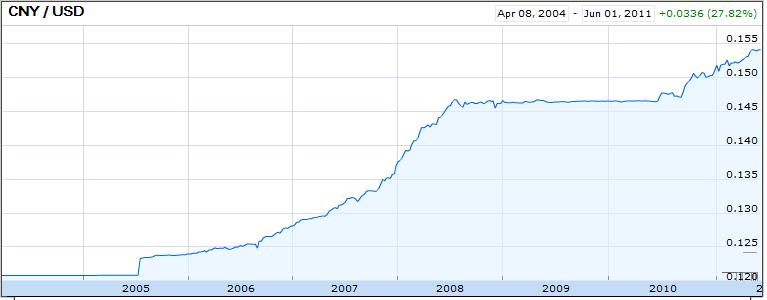
Over the last six years, the appreciation of the Chinese Yuan has been as reliable as a clock. Since 2005, when China tweaked the Yuan-Dollar peg, it has risen by 28%, which works out to 4.5% per year. If you subtract out the two year period from 2008-2010 during which the Yuan was frozen in place, the appreciation has been closer to 7% per year. There is no other currency that I know of whose performance has been so consistently solid, and best of all, risk-free!
As I wrote in an earlier post on the subject, the economic case for further appreciation is actually somewhat flimsy. When you factor in the 5-10% inflation that has eroded the value of the Yuan over the last few years, its appreciation in real terms has more than exceeded the 25-40% that economists and politicians asserted as the margin by which it was undervalued. While prices for many services remain well below western levels, prices for manufactured goods already equal or exceed those that Americans pay. (As a resident of China, I can assure you that this is the case!). Given that Chinese GDP per capita (a proxy for income) is 12 times less than in the US, that means that relative price levels in China are already significantly greater than the US. Thus, further appreciation would only cause further distortion.

Regardless, investors continue to brace for further appreciation, and expectations of 5-6% for the foreseeable future are the norm. Even futures contracts – which typically lag actual appreciation because of their non-deliverable nature – are pricing in higher expectations for appreciation. Perhaps the greatest indication is that 9% of all of the capital pouring into China is so-called “hot-money.” That means that despite the 27% appreciation to date, a substantial portion of investment in China is connected only to the expectation for further Yuan appreciation.

Even though the Yuan is not fully-tradeable, its continued rise has serious implications for forex markets. First of all, there will be follow-on effects for other currencies. Almost every emerging market economy competes directly with China, and all are thus keenly aware that China pegs its currency against the US dollar. By extension, many of these economies feel they have no choice but to intervene daily in forex markets to prevent their respective currencies from appreciating faster than the RMB.

At the very least, the appreciation in Asian and Latin American currencies will keep pace with the Yuan: “This is a long-term secular trend for emerging market currencies especially in Asia. Asian currencies have long been undervalued and they are on a convergence path with the United States and the G7 more broadly and that’s going to lead to an appreciation,” summarized one analyst.

All of this action will cause the dollar to depreciate. The Chinese Yuan alone accounts for 20% of the Federal Reserve Bank’s trade-weighted dollar index, and Asia ex-Japan accounts for another 20%. Regardless of the other G4 currencies perform, that means that a conservative 7% annual appreciation in Asia will drive a minimum 3% annual decline in the trade-weighted value of the dollar. Even worse is that this cause a broad loss of confidence in the dollar, driving the dollar lower across-the board. And this doesn’t even aaccount for the multiplier effect that net exporters will no longer need to indiscriminately accumulate dollar-denominated assets. China, itself, has unloaded part of its massive hoard of US Treasury securities for five consecutive months.
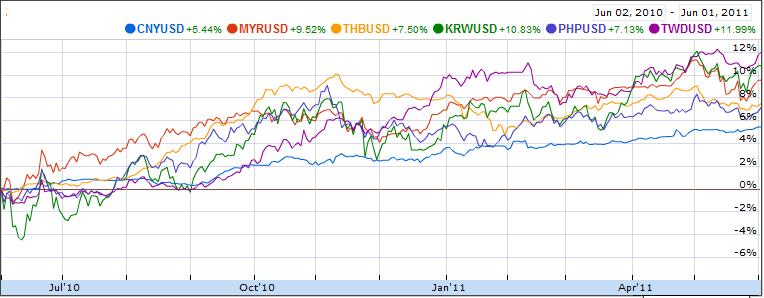
The implications for how long-term investors should position themselves are clear. Unfortunately, while further appreciation in the Chinese Yuan is all but guaranteed, achieving exposure to this appreciation is beyond difficult. Neither of the ETFs that claim to represent the Yuan (CNY, CYB) have budged over the last couple years, and they are a poor substitute for the actual thing. In other words, your only chance for exposure is indirectly via Chinese stocks and bonds, which are far from transparent and an extremely dubious investment. Or you could try opening a Chinese Yuan bank account with the Bank of China (which now has branches in the US), but it’s unclear whether you will be able to capture 100% of gains from the Yuan’s appreciation.

Otherwise, emerging market Asia seems like a pretty good proxy. Of course, you need to be aware that even though the Korean Won, Malaysian Ringgit, Thai Baht, New Taiwan Dollar, Indonesian Rupiah, Philippine Peso, etc. will probably at least match the rise in the Yuan, they are imperfect substitutes for the Yuan, since they are driven more by country-specific factors than by association to China.


View the original article here
More about→

Aussie is Breaking Away from Kiwi

Diposting oleh FXprofit

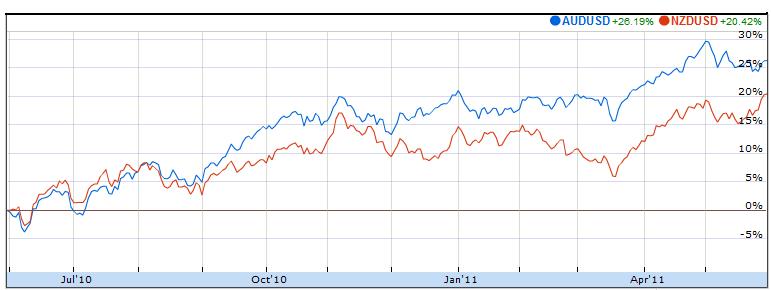
The correlation between the Australian Dollar and New Zealand Dollar is among the strongest that exists between two currencies. Given their regional bond and similar dependence on commodities to drive economic growth, perhaps this is no wonder. Over the last year, however, the Aussie has slowly broken away from the Kiwi. While the correlation between the two remains strong, the emergence of distinct narratives has given rise to a clear chasm, which can be seen in the chart below. Given that the NZD is evidently among the most overvalued currencies in the world, does that mean the same can be said about the AUD?

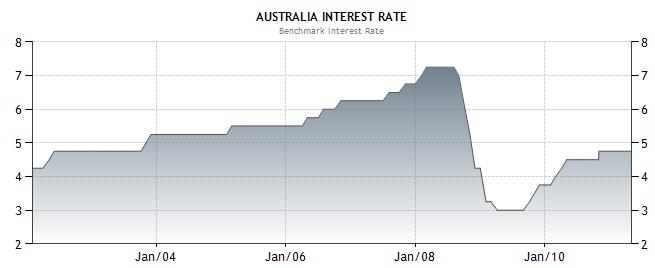
Alas, geographic proximity aside, the two economies have very little in common. Australia is rich in coal, precious metals and other natural resources , while New Zealand produces and export primarily agricultural products. Granted, the prices for both types of commodities have exploded over the last decade (and especially the last year), but let’s be clear about the distinction. This has enabled both economies to achieve trade surpluses, but oddly current account deficits. Australia’s economy is projected to grow by more than 4% in 2011, compared to 2% in New Zealand. Australia’s benchmark interest rate is also higher, its capital markets are deeper, and the supply of its currency necessarily exceeds that of New Zealand.

Taken at face value, then, it would seem commonsensical that the Aussie should rise both against the Kiwi and the US Dollar. Indeed, it recently touched an all-time high against the latter, and is now firmly entrenched above parity. On a trade-weighted basis, it has been among the world’s best performers over the last two years.

In fact, some are wondering (myself included), whether the Australian Dollar might have risen too much for its own good. According to OECD valuations based on purchasing power parity (ppp), the Aussie is now 38% overvalued against the dollar, behind only the Swiss Franc and Norwegian Krone. In fact, exporters of non-commodity products (i.e. those whose customers are actually price-sensitive) have warned of mounting competitive pressures, declining sales, and inevitable price cuts. In other words, the portion of the Australian economy that doesn’t deal in commodities is actually in quite fragile shape. Given that China’s economy is projected to slow over the next two years and that booming investment in Australia’s mining sector should boost output, the commodity sector of the economy might soon face similar pressures.

For that reason, the Reserve Bank of Australia (RBA) has avoided raising its benchmark interest rate is fast as some analysts had expected, and inflation hawks had hoped. There is a chance for a 25 basis point hike as soon as June – bring the base rate to an even 5% – but the RBA’s own statements indicate that it probably won’t be until June and July. Regardless of when the RBA tightens, Australian interest rate differentials will remain strong for the foreseeable future, and likely continue to attract speculative inflows for as long as risk appetite remains strong.

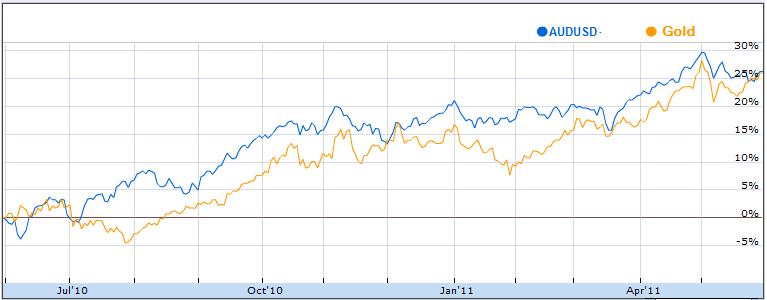
So why does the Australian dollar continue to rise? It might have something to do with gold. As you can see from the chart above, the correlation between the Aussie and gold prices is almost just as strong as the relationship between the Aussie and the Kiwi. Given that Australia is the world’s second largest gold exporter, it is perhaps unsurprising that investors would see rising gold prices as a reason for buying the Australian dollar. However, it seems equally possible that demand for both is being driven by the pickup in risk appetite. While some gold buyers might counter that gold is best suited for those who are averse to risk (i.e. afraid that the financial system will collapse), the performance of gold over the last five years suggests that in fact the opposite is true. When risk appetite is high, speculators have bought gold and the Australian dollar (among other assets).

It’s unclear whether this will remain the case going forward. The Wall Street Journal recently reported that gold is increasing attracting risk-averse investment, as buyers fret about the eurozone sovereign debt crisis and other threats to the system. However, the same cannot be said about the Australian Dollar. For as long as risk is “on,” demand for the Aussie will remain intact. And if the Aussie Dollar Barometer survey – which found that “exporters expect the Australian dollar to reach a post-float record of $US1.16 by September and to remain above parity well into next year” – is any indication, risk appetite will indeed remain strong for the foreseeable future.


View the original article here

More about→
Open InstaForex

Follow

easy blog designer. Diberdayakan oleh Blogger.